Case Study
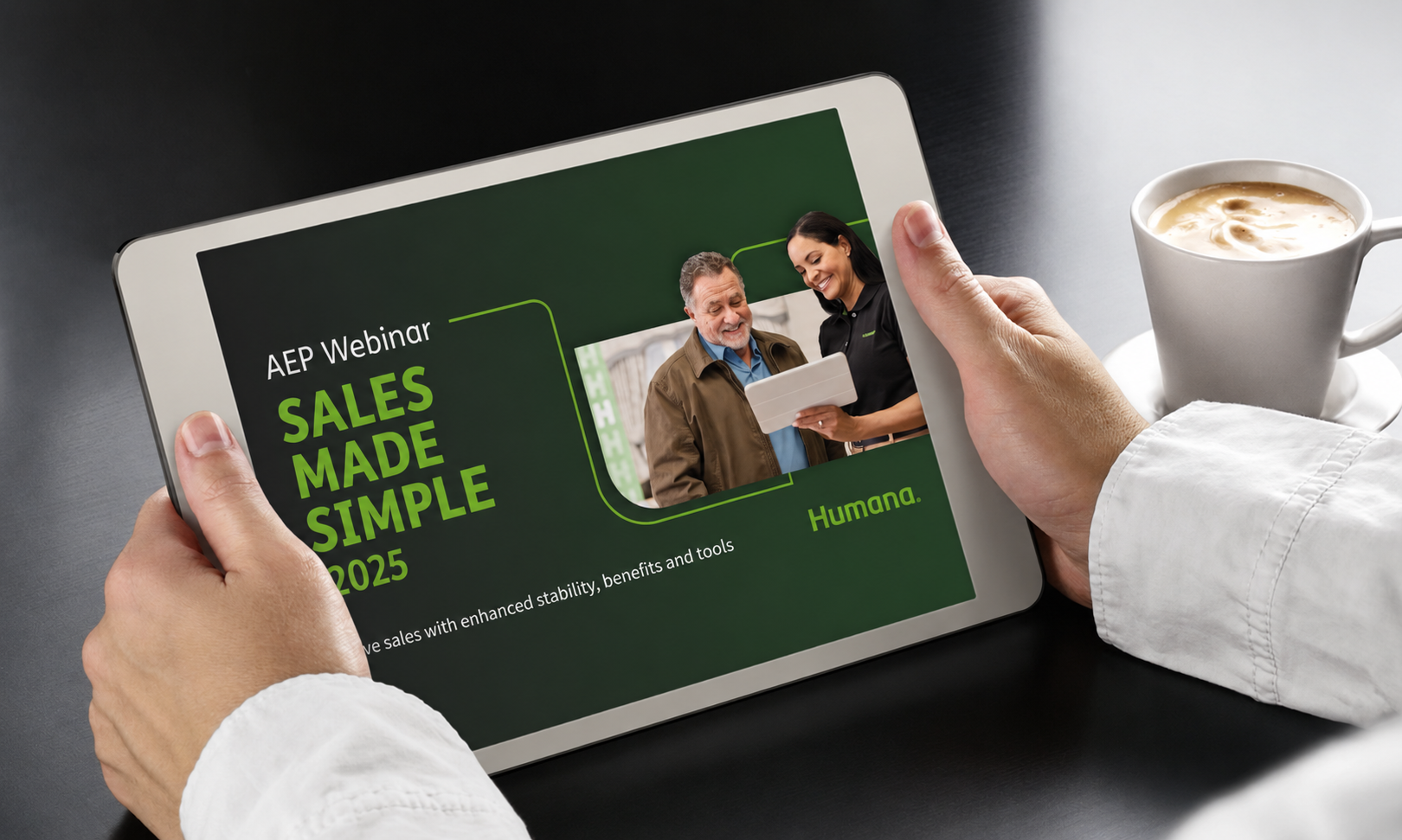
Humana AEP Webinar Growth
Redesigning a stagnant Medicare agent webinar into a full-funnel demand engine, driving 73% more registrations and the best attendance in four years.
Business Challenge
Humana's Medicare Advantage business depends almost entirely on independent agents. They're responsible for 95% of Humana's sales, which makes AEP Readiness, the marketing push ahead of Medicare's Annual Enrollment Period, one of the most important campaigns on the calendar every year.
The AEP webinar was one of a dozen tentpole moments competing for agent attention during that window, and in past years it had underperformed as a demand driver. Promotion leaned on a single branded email invite, with no real strategy connecting awareness, nurture, and the live experience itself. Heading into AEP Readiness '25, the team set out to change that.
Strategic Insight
Agents are busy, skeptical of "corporate" messaging, and already fielding a steady stream of certification, product, and event emails during AEP season. Past performance data made it clear that a single generic invite wasn't going to move the needle.
Growth would come from showing up in more places, in a more personal voice, and building a live experience worth showing up for. Essentially, treating the webinar as a full funnel rather than a single send.
The Approach
As the digital strategist on the campaign, I helped rebuild the webinar's promotion strategy from the ground up. Rather than relying on email alone, we layered awareness placements across every high-traffic surface on the agent portal: a countdown clock, homepage carousel, homepage tile, and a lightbox that alone drove roughly 417 interactions a day, one of the strongest-performing placements of the entire campaign.
On top of that reach, we replaced the old one-and-done invite with a sequenced cadence: initial invite, personalized text-based invite, an "on-the-fence" nudge, and a last-chance reminder. We also tested plain-text emails written as if they came directly from the presenters against the standard branded template. The personal format won, becoming the second-highest-converting channel and outperforming the branded send on open rate.
We carried that same thinking into the live event itself, shifting the delivery from a scripted read to a more conversational, bullet-point format to hold agents' attention once they'd shown up. And for the agents who registered but didn't attend live, we built a dedicated on-demand follow-up so the funnel didn't end at the no-show.
Results
The redesigned funnel made this the best-performing AEP webinar in four years.
- +73% Registration growth year-over-year (6,541 → 11,281)
- +109% Attendance growth year-over-year
- 69% Average watch-through rate (up from 57%)
- 21% Of registrations driven by personalized presenter emails
Beyond the campaign numbers, the personalization test became a validated, repeatable tactic the broader team could apply to future agent communications.
My Role
Channel Strategy
Helped design the multi-channel awareness layer, identifying which placements on the agent portal would extend reach beyond email alone.
Email Marketing
Built and sequenced the registration nurture cadence, including the personalized presenter email test that outperformed the standard template.
Content Optimization
Contributed to reshaping the live webinar format to improve attention and watch-through once agents joined.
Campaign Analysis
Analyzed channel and funnel performance to identify what was and wasn't working, informing the recommendations carried into the next year's campaign.
Reflection
The clearest lesson from this campaign was that funnel thinking beats channel thinking. It would have been easy to treat the webinar as one deliverable: send the invite and count the registrations. Instead, breaking it into awareness, nurture, content experience, and recovery gave us a lever at every stage, and made it obvious which changes were actually driving the growth rather than guessing at what worked.